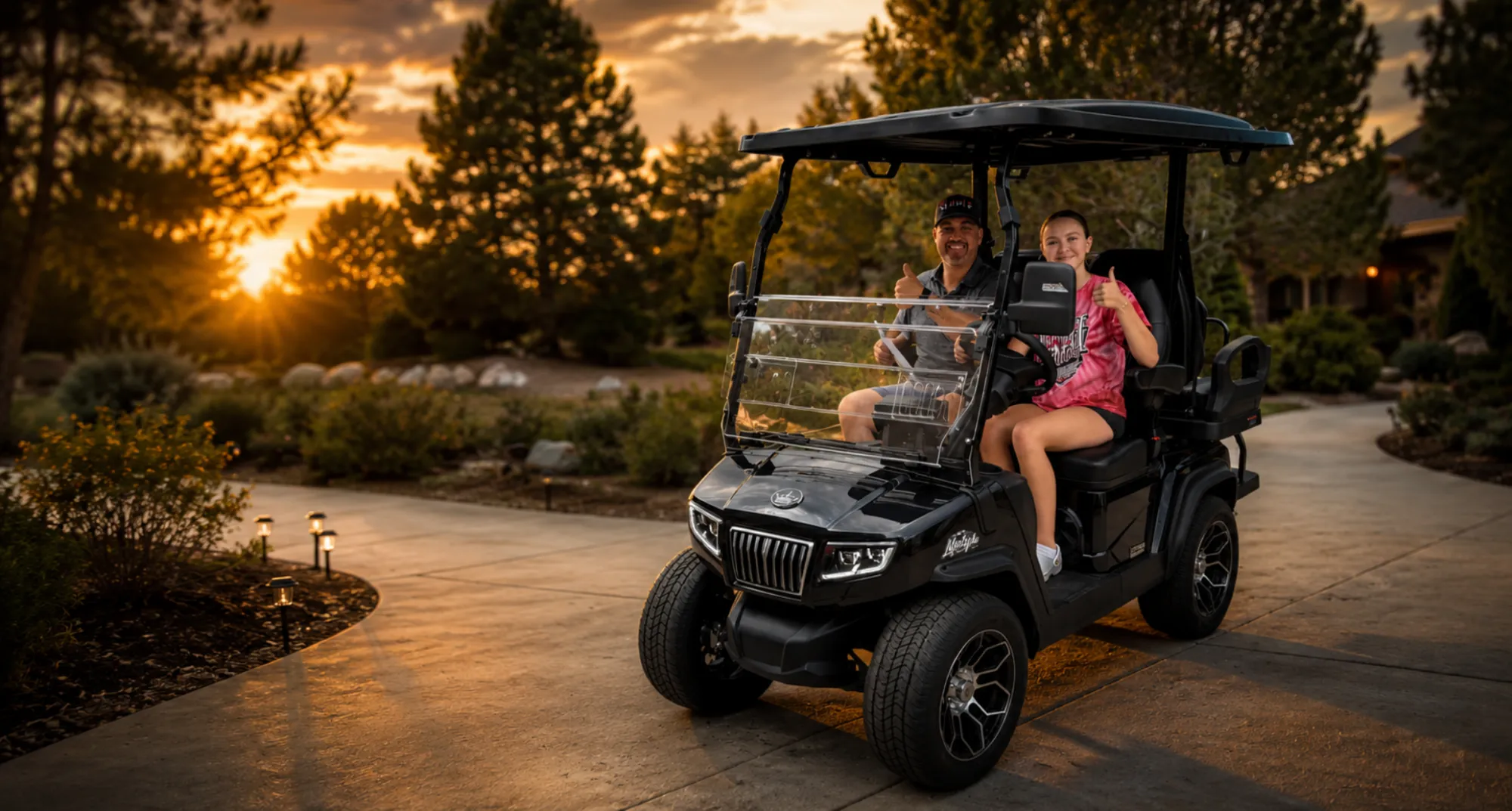
Golf Carts for Sale and How to Choose the Right Type for You
Electric or gas, 2 to 6 seats, lifted or standard, personal or street-legal: the types of golf carts for sale and the questions that decide which one is yours.
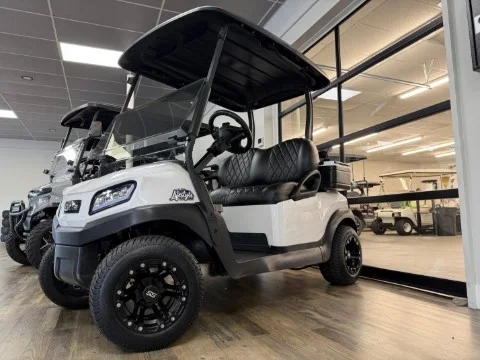
The types of golf carts are easiest to understand as five choices rather than one list: how the cart is powered (gas, lead-acid electric or lithium), how many it seats and which way they face, whether it is lifted, what it legally is (a golf car, a personal transport vehicle or a street-legal low-speed vehicle), and whether it carries people or cargo. Pick one answer in each and you have described the cart you should buy.
TL;DR
Golf carts sort five ways. Power comes as gas, lead-acid electric or lithium electric, and E-Z-GO sells its RXV 2 all three ways. Seating runs from two, through a 2+2 with rear passengers facing back and four facing forward, to six and more. Height is standard for paths and pavement or lifted for gravel and trails.
The legal category matters most for street use: under the ANSI standards a golf car averages under 15 mph, a personal transport vehicle stays under 20 mph, and a low-speed vehicle is capped at 25 mph with a VIN. Last comes the job: passenger carts carry people; utility carts like Cushman's Hauler carry hundreds of pounds in a bed and can tow. Decide each one in turn and the right cart is obvious.
The Five Ways Golf Carts Are Sorted
| Choice | Options | What decides it |
|---|---|---|
| Power | Gas, lead-acid electric, lithium electric | Range between stops, upkeep, winter storage, street use |
| Seats | 2, 2+2, 4 forward, 4+2, 6, 8 | Who rides with you, now and next year |
| Height | Standard or lifted | Pavement and turf, or gravel and trails |
| Legal category | Golf car, personal transport vehicle, low-speed vehicle | Where you plan to drive it |
| Job | Passenger or utility | People, or tools and cargo |
The Five Choices in Detail
Each choice below is independent, so you can settle them one at a time and in any order, though power and legal category are the two that are hardest to change later.
Power: gas, lead-acid electric or lithium
The big makers still sell all three, often on the same model. E-Z-GO offers its RXV 2 with a 48-volt lead-acid system, an ELiTE lithium pack or a 13.5-horsepower gas engine.
| Power | Starting price on the RXV 2 | Best for |
|---|---|---|
| 48V lead-acid electric | $9,274 (Valor S) | The lowest price, light use, owners who keep up with charging |
| 13.5-hp gas | $9,487 (Valor S) | Long days far from an outlet, heavy work |
| ELiTE lithium electric | $11,844 (Freedom) | Little upkeep, winter storage, long ownership |
Most new electric carts now ship with lithium as standard, and the newer brands build lithium carts only. Our comparison of gas and electric golf carts goes deeper on cost, upkeep and cold weather.
Seats and layout
Seat count and layout change how a cart drives as much as who it carries.
| Layout | Who it suits | Note |
|---|---|---|
| 2 seats | Golfers, couples | Smallest, easiest to park and store |
| 2+2 | Two adults plus kids or gear | Rear seat faces back and often flips to a cargo deck |
| 4 forward | Families | Everyone faces the front; more comfortable for longer rides |
| 4+2 | Bigger families | Four forward plus a rear-facing pair |
| 6 forward | Groups, large families | Longer cart, bigger turning circle |
| 8 | Resorts, events, businesses | Usually sold for commercial use |
Six-seat and larger carts carry more than four people, which takes them outside Colorado's statutory definition of a golf car, so check your town's rules before planning to drive one on streets.
Standard height or lifted?
A standard-height cart sits low on street or turf tires. It is easier to climb into, more stable in tight turns and kinder to golf course grass. A lifted cart sits higher on bigger, often all-terrain tires, with more ground clearance for gravel roads, dirt drives and trails.
Around Colorado Springs, the choice often follows the address. Paved neighborhoods in town suit standard carts; properties in Black Forest, Falcon or Peyton, with long gravel drives, suit lifted ones. Our golf cart size and dimensions guide helps check that a lifted or six-seat cart will fit your garage.
Golf car, personal transport vehicle or low-speed vehicle?
This is the type distinction most buyers do not know exists, and it decides where the cart may go. The industry standards maintained by ILTVA define the first two by speed:
| Category | What defines it | Typical use |
|---|---|---|
| Golf car (ANSI/NGCMA Z130.1) | Averages less than 15 mph on level ground | Golf courses |
| Personal transport vehicle (ANSI/NGCMA Z135) | Under 20 mph, 4+ wheels, not more than four persons | Communities and private property |
| Low-speed vehicle | Up to 25 mph under the federal standard, with required lights, mirrors, belts, windshield and a VIN | Public streets where allowed |
In Colorado, a titled low-speed vehicle has to be electric, because the state defines a low-speed electric vehicle by its electric propulsion and VIN. A golf car may use public roads only where a city or county allows it by ordinance. If street driving matters to you, decide this before anything else.
Utility carts: when you need a bed, not seats
Some buyers need to move tools, feed, firewood or equipment more than people. That is the job of a utility cart, built with a cargo bed and load ratings a passenger cart does not have.
Cushman's utility line shows what those ratings look like. Its Hauler 800 starts at $11,499 with two seats, an 800-pound vehicle load capacity and a 400-pound bed, and tows up to 900 pounds with an optional hitch. Its lithium-only Hauler PRO starts at $15,562 with a 1,200-pound vehicle load, an 800-pound bed, up to 1,500 pounds of towing and a top speed of about 16.5 mph.
| Utility example | Vehicle load | Bed load | Towing |
|---|---|---|---|
| Cushman Hauler 800 | 800 lb | 400 lb | Up to 900 lb with optional hitch |
| Cushman Hauler PRO | 1,200 lb | 800 lb | Up to 1,500 lb |
Passenger carts are not built for loads like these. If the work is regular, buy a utility cart rather than overloading a passenger one.
There is a middle ground. A passenger cart with a flip-down rear seat or a cargo box handles light jobs: groceries, a cooler, a bag of feed, a few tools. What it lacks is a rated bed, a rated hitch and the frame and brakes behind those ratings. If you are moving loads every week, or towing anything at all, the ratings matter more than the seats. Evolution's Turfman line is another utility option we can help with.
Golf Cart Types by Brand
Each brand covers the types differently, which narrows the field once you know what you want. From the makers' own model lists:
| Brand | Types offered |
|---|---|
| E-Z-GO | Two- and four-seat RXV, Liberty in LSV form, Express six-seater; gas, lead-acid and lithium |
| Club Car | Onward in 2, 4 and 6 passenger, lifted or not; gas, flooded lead-acid and lithium |
| Evolution | D5 and D-Max four- and six-seaters (D-Max XT with 4WD), lifted Forester, Classic, Carrier group carts, Turfman utility; lithium |
| Denago EV | Two-seat Scout 2, four-seat Rover XL, lifted 2+2 Nomad XL, 4+2 Rover XL6; lithium |
| ICON and EPIC | Two-, four- and six-seat i-series and EPIC FX carts; lithium |
If you already know your type, a brand's lineup tells you quickly whether it builds one. A lifted six-seater with four-wheel drive, for example, narrows the list to very few carts.
Which Types Suit Colorado Springs?
Local conditions push buyers toward some types more than others.
- Hills favor a strong electric drivetrain or gas, and good brakes; test any cart on a grade with passengers.
- Winter favors lithium, which holds its charge through months of storage better than lead-acid.
- Gravel roads east of town and toward Black Forest favor lifted carts with all-terrain tires.
- Street use depends on your town's ordinance for golf cars, or on owning a titled electric low-speed vehicle.
- Homeowners' associations may set their own rules on carts, parking and charging, so ask before you buy.
Taken together, those conditions point to a four-seat lithium cart for most of the days described above: standard height in town, lifted out of town.
Can You Change a Cart's Type Later?
Some type choices can be changed after you buy. Others cannot, and those are the ones to get right first.
| Change | Possible later? | What it takes |
|---|---|---|
| Standard to lifted | Yes | A lift kit with matching steering and brake parts, plus bigger wheels and tires |
| Lead-acid to lithium | Yes | A lithium pack certified to UL 2271 and the charger made for it |
| Rear-facing seat to cargo deck | Often | A flip seat or rear seat kit |
| Golf car to street-legal LSV | Rarely | Not just lights; it needs the federal equipment list, compliant windshield and a VIN |
| Gas to a titled LSV in Colorado | No | Colorado's low-speed electric vehicle definition requires electric propulsion |
| Two seats to six | No | Buy the right size; the frame is different |
The pattern: power and height can be upgraded, but seat count and legal category are built in. Choose those two carefully.
Golf Cart Type Mistakes to Avoid
- Buying two seats for a family that will need four within a year.
- Buying a gas cart for street use in Colorado, where only electric carts can be titled as low-speed vehicles.
- Buying a lifted six-seater without measuring the garage.
- Buying a passenger cart for regular hauling, then overloading it and wearing out its brakes and suspension early.
- Assuming a golf car can legally drive on any street; check the town's ordinance first.
Which Type of Golf Cart Is Right for You?
Match the type to your most common day, not your rarest one.
| Your most common day | The type that fits |
|---|---|
| A round of golf | Two-seat electric, standard height, golf car |
| Neighborhood loops with family | Four-seat electric, forward-facing, standard height |
| Errands on public streets | A titled electric low-speed vehicle |
| Gravel roads and acreage | Lifted electric or gas, four seats, all-terrain tires |
| Long workdays far from power | Gas, or a large lithium pack |
| Hauling and towing | A utility cart with a rated bed and hitch |
| Events and groups | Six or eight seats |
If two rows fit, choose for the harder one. A lifted four-seater handles the neighborhood fine; a low two-seater will not handle the gravel road.
A test drive settles close calls. Drive the two types you are torn between on the same route, with the same passengers, and the differences in ride, entry, turning and pull up a hill are usually clear within a few minutes.
New, Used or Custom?
Once you know the type, decide how to buy it. New carts carry full warranties and current features. Used carts cost much less, and a careful inspection of a used golf cart tells you whether one is worth it. Custom builds start from a factory base and add the seats, lighting, wheels and finish you want. A sensible route for many buyers is to settle the type first, then compare a new cart of that type against a used one a few years old; the price gap usually decides it, as long as the used cart's battery checks out. Our look at the five golf cart features that matter most helps compare carts of the same type.
See Every Type on One Lot
The golf carts for sale on our Colorado Springs lot list their seats, power and condition, from two-seaters to six-seaters, new and used. Drive two types back to back at Lifestyle Golf Carts, 2205 Montebello Square Dr., and the right one usually becomes obvious within a block.
Frequently Asked Questions
What are the different types of golf carts?
Golf carts differ by power (gas, lead-acid electric, lithium), seats and layout (2, 2+2, 4, 4+2, 6, 8), height (standard or lifted), legal category (golf car, personal transport vehicle, low-speed vehicle) and job (passenger or utility). One choice in each describes the cart.
What is the difference between a golf cart and a low-speed vehicle?
Under the ANSI standards a golf car averages under 15 mph. A low-speed vehicle can reach up to 25 mph, carries the federal list of lights, mirrors, belts and windshield, and has a VIN. In Colorado, only an electric low-speed vehicle can be titled for the road.
What is a utility golf cart?
A utility cart carries cargo in a rated bed and can often tow. Cushman's Hauler 800, for example, carries an 800-pound load with a 400-pound bed and tows up to 900 pounds with an optional hitch. Passenger carts are not built for those loads.
Should I get a lifted golf cart?
Choose lifted if you drive gravel, dirt or trails, or need ground clearance. Choose standard height for pavement, cart paths and turf, easier entry and tighter garages. Lifted carts sit on bigger tires and handle tight turns less steadily.
Which type of golf cart is best for a family?
A four-seat electric cart with forward-facing rear seats and a seat belt at every seat suits most families. Larger families look at 4+2 or six-seat layouts, checking local street rules for carts that seat more than four.