How Evolution Golf Carts Are Changing the Golfing Experience
Who makes Evolution golf carts, who backs the warranty, and what the D5 forward-facing seats, lithium packs and lift kits changed on the course and off it.

Evolution golf carts are sold by Evolution Electric Vehicles, and the company that stands behind them in the United States is named in Evolution's own warranty terms: HDK Plastic Factory LTD USA, which warrants the carts to the original buyer through authorized Evolution dealers. What Evolution changed for golfers is mostly about seating and power: a four-seat cart with every seat facing forward, a trunk that lifts out to leave a golf bag well, and lithium batteries across the line.
TL;DR
Who makes Evolution golf carts? Evolution's published warranty names HDK Plastic Factory LTD USA as the warrantor for Evolution vehicles sold through authorized dealers. The brand's best-known change is the D5's forward-facing layout: four or six seats all facing the front, with a portable trunk that comes out to make room for a golf bag. Evolution says similar all-forward designs have since appeared across the market.
Its carts run lithium packs, and the published spec for its 48-volt 100Ah pack allows charging only between 32 and 110 degrees Fahrenheit, which matters in a Colorado winter. The warranty covers the original registered buyer, so a second owner should ask what is left. And a six-seat Evolution sits outside Colorado's four-person golf car definition.
Who Makes Evolution Golf Carts?
The clearest answer comes from Evolution's own paperwork rather than its marketing. The Evolution warranty terms open with the line that "HDK Plastic Factory LTD USA warrants to the original retail registered purchaser sold by a duly authorized Evolution Electric Vehicles dealer." In other words, Evolution is the brand on the cart, and HDK is the company that answers for its defects in the United States.
The company's About page describes the brand's focus on body design and upgrade choices, without naming a founding date or factory. So we stick to what the warranty states, and we do not repeat the assembly locations and origin stories that circulate on forums without a document behind them.
One thing to watch: Evolution golf carts live at evolutionelectricvehicle.com. A similarly named company at a different address makes EV components and has nothing to do with these carts, which trips up a lot of people researching the brand.
The Forward-Facing D5 Changed What a Golf Cart Looks Like
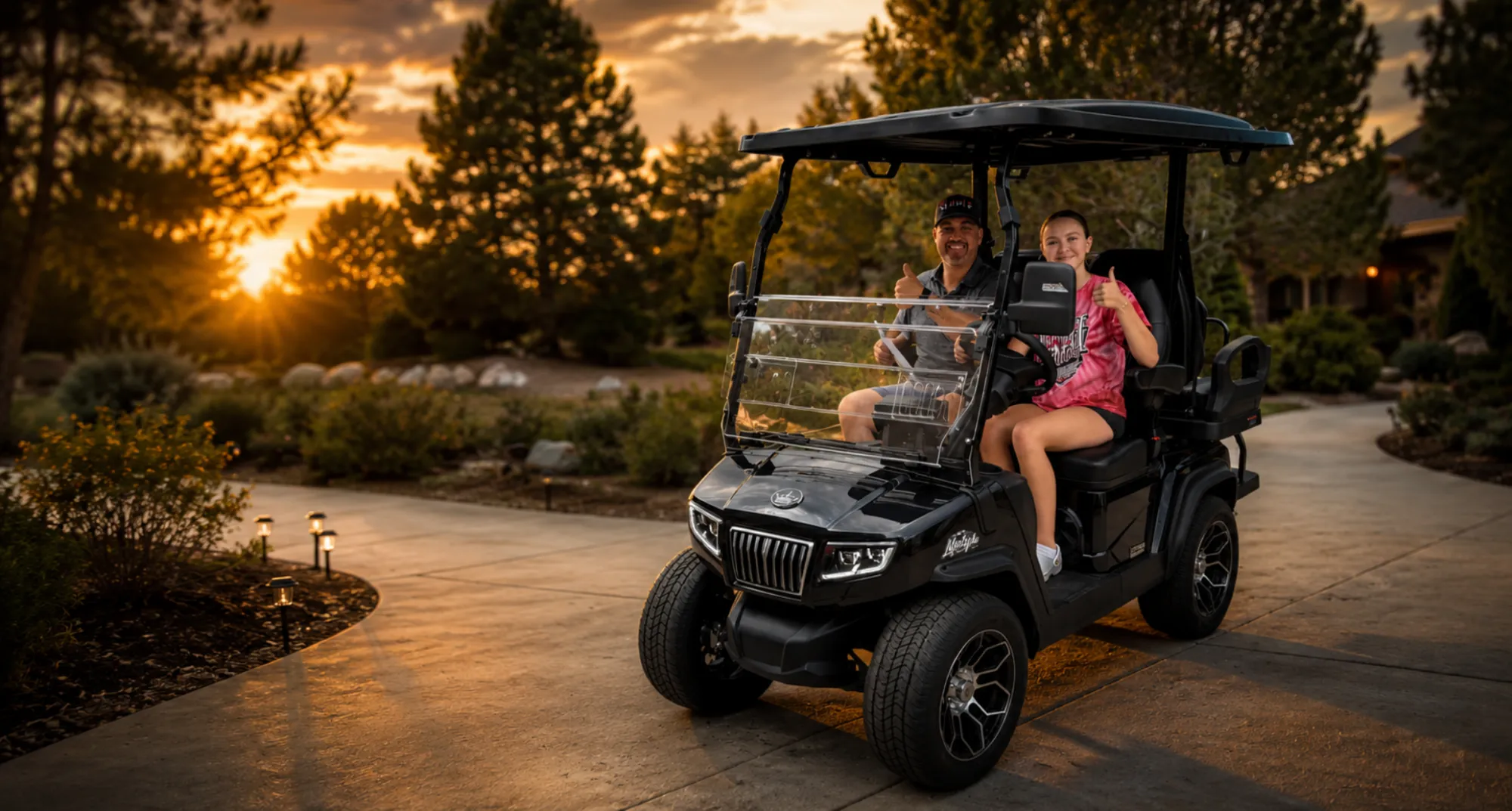
For most of golf cart history, a four-seat cart meant two seats forward and a flip seat facing backward. Evolution's D5 line put all four seats facing the front. On its own homepage, Evolution says the D5 introduced a "premium all-forward seating configuration," and that since the D5 became popular, "similar all-forward seating designs have appeared across the market."
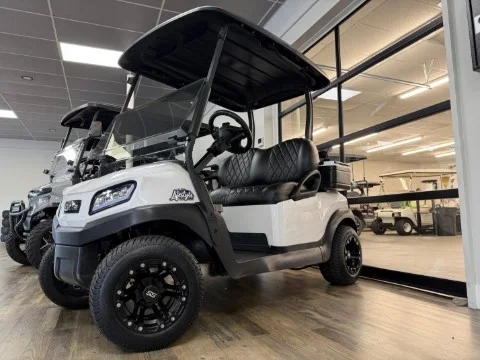
For golfers, the detail that matters is behind the back seat. The D5 carries a built-in portable trunk, and Evolution says that when the trunk is removed, the space converts into a bag well. That makes the same cart work for a round on Saturday and a neighborhood loop with the family on Sunday, which is the job most people now buy a cart for.
The D5 page lists eight models, in four-seat and six-seat versions, lifted or not:
| D5 model | Seats | Lifted | Rear seats |
|---|---|---|---|
| Ranger 4 Plus | 4 | No | Forward facing |
| Maverick 4 Plus | 4 | Yes | Forward facing |
| Ranger 2+2 Plus | 4 | No | Rear facing |
| Maverick 2+2 Plus | 4 | Yes | Rear facing |
| Ranger 6 Plus | 6 | No | Forward facing |
| Maverick 6 Plus | 6 | Yes | Forward facing |
Across the line, Evolution lists a 6.3 kW motor and a lithium battery, along with a touchscreen with Apple CarPlay and Android Auto, a backup camera, seat belts for every seat and LED lighting. The Evolution D5 series lineup gives a starting MSRP of $9,699, and the homepage showed promotional pricing valid through November 30, 2026, with the dealer setting the actual price.
Buying a used D5? Check the trunk and the screen
Two D5 features are easy to lose on a used cart. The portable trunk lifts out by design, so make sure it comes with the cart, or the bag well is all you get. And the touchscreen, backup camera and powered side mirrors are part of what you are paying for, so test each one with the seller before you agree on a price. A dead screen on a used cart is a repair you would rather price in than find later. Ask for the charger that came with the cart too, because a lithium pack should be charged with the charger matched to it.
Maverick or Ranger?
The Maverick versions add a brush guard and side steps on a lifted chassis. That suits gravel drives, trail access and properties outside town. The Ranger versions sit lower, which is easier for getting in and out and better on paved neighborhood streets and cart paths.
Lithium Across the Line, and What a Colorado Winter Does to Charging
Evolution builds its carts around lithium packs instead of the lead-acid batteries that powered golf carts for decades, and it publishes a spec sheet for each Evolution lithium pack. For the 48-volt, 100Ah pack it lists:
| Spec (L48100 pack) | Published figure |
|---|---|
| Stored energy | 4.8 kWh |
| Life cycles | More than 3,500 |
| Self-discharge | Up to 3.2% per month |
| Range, 2-seat cart at 13 mph | 40 to 50 miles per full charge |
| Standard charging time | 4 to 5 hours |
| Charge temperature range | 32 to 110 degrees Fahrenheit |
| Discharge temperature range | -4 to 140 degrees Fahrenheit |
The range figure is the manufacturer's, measured on a two-seat cart at 13 mph, so a loaded six-seater climbing hills will see less.
The line Colorado owners should read twice is the charge temperature. The pack is rated to discharge down to -4 degrees, so it will drive on a cold morning, but it is rated to charge only from 32 degrees up. A cart parked in an unheated garage or a carport in Colorado Springs, Monument or Woodland Park in January can sit below freezing for days. If yours lives somewhere like that, move it somewhere above freezing before you plug it in, and leave it unplugged until it is.
The low self-discharge is the good news for winter. A lead-acid pack left unplugged all winter can sulfate and lose capacity; a lithium pack losing at most 3.2% a month comes out of a three-month layup with most of its charge still there.
What Lithium Changed for Golfers
For a golfer, the switch from lead-acid to lithium changes the routine more than the ride. The battery material Evolution publishes says lithium needs minimal maintenance and that a lithium pack "accepts both partial and rapid charging." The same material notes that sealed lead-acid packs need topping off with distilled water every few months, and that a cell left to run dry stops holding a charge.
In practice that means three things on a course day. There is no watering schedule to keep. A short top-up between a morning nine and an afternoon round is fine rather than harmful. And the spec sheet's quick-charge time of 1 to 2 hours, against 4 to 5 for a standard charge, means a cart that came back low at lunch can be useful again by mid-afternoon.
None of that makes lithium free of care. The cold-charging limit above still applies, and a pack stored for months should be checked before the season starts.
What the Evolution Warranty Means If You Buy One Used
The warranty is generous on paper, and it is written for the first owner. The warranty terms list:
- All EV product lines: 2 years on parts
- Lithium battery: 5 or 8 years, conditions apply
- Evolution charger and controller: 4 years each
- Frame: lifetime, where the frame means the chassis, not drive train, suspension, roof supports, paint or corrosion
- Eight-passenger carts, buses and bubble cars: 1 year
- Rental, taxi or other heavy-use vehicles: 6 months, and they must be registered that way
Two lines change the picture for a used buyer. The warranty is made "to the original retail registered purchaser" through an authorized dealer, and the terms say it "applies only to the authorized dealers, not to any subsequent dealers and end users," with authorized dealers fulfilling it for them. So before you pay for a used Evolution, ask three questions: who bought it first, from which dealer, and when. A two-year-old cart bought from an authorized dealer may still have battery coverage left that a dealer can act on. A cart that came through a reseller or a rental fleet may have less, or none.
Wear parts sit outside the parts warranty in every case: windshield, wheel bearings, lights, top, tires, brakes and seats.
Six Seats and the Colorado Golf Car Definition
Evolution sells six-seat versions of its D5, D-Max, Forester and Carrier lines, and they raise a Colorado-specific question. Under C.R.S. 42-1-102, a "golf car" has a design speed under 20 mph, at least three wheels, an empty weight of no more than 1,300 pounds and a carrying capacity of not more than four persons.
A six-seat cart carries more than four people, so it does not fit that definition. That matters if you plan to drive on neighborhood streets, because Colorado lets each city or county authorize golf cars on its roads by ordinance. Before you buy a six-seater for street use in Colorado Springs, Fountain or Castle Rock, ask the town how it treats a cart that seats six, and whether it needs to be a titled low-speed vehicle instead. On a private course or a large property, the definition does not change anything.
Evolution Golf Cart Models Beyond the D5
The D5 gets the attention, but Evolution's menu runs wider. Its site lists the D-Max series (XT4, GT4, XT6, GT6), the Classic line (Classic 2 Plus and Classic 4 Plus), the Forester line (Forester 4 Plus and 6 Plus), the Carrier 6 Plus and Carrier 8 Plus, and Turfman utility vehicles (200, 800 and 1000 Plus) for work rather than people. Our guide to every Evolution model line goes through what sets each one apart, and the Evolution model years we list show what each year's lineup looked like.
If you are comparing a used Evolution, the model-year search people run most often on our site is for the 2025 and 2023 carts, and the Classic 4 Plus shows up often in those searches.
Evolution Golf Cart Reviews: What to Weigh
We would rather tell you what to check than hand you a star rating. On an Evolution, weigh these honestly:
- Where you will charge. The 32 degree charging floor is a real limit in a cold garage.
- Who bought it first. The warranty follows the original registered buyer through an authorized dealer.
- Seats versus where you drive. A six-seater is great for a family, and it falls outside Colorado's four-person golf car definition on public roads.
- Screen and electronics. A touchscreen, backup camera and powered mirrors add comfort and add parts that can fail. Ask whether they all work on a used cart.
- Lifted or not. A Maverick rides higher and handles rough ground; a Ranger is easier to climb into every day.
None of these rules a cart out. Each is a question with an answer you can get before you pay.
Drive an Evolution Before You Decide
The forward-facing seats and the lithium drive make more sense from behind the wheel than from a spec sheet. The Evolution golf carts for sale at our Colorado Springs store are the quickest way to feel the difference between a Ranger and a Maverick. Ordering a model we do not have, and getting the lithium battery warranty registered, both run through our Evolution sales and service team. Our service department works on every brand, Evolution included. Stop by Lifestyle Golf Carts at 2205 Montebello Square Dr. to sit in one.
Frequently Asked Questions
Who makes Evolution golf carts?
Evolution golf carts are sold under the Evolution Electric Vehicles brand. Evolution's published warranty terms name HDK Plastic Factory LTD USA as the company that warrants the vehicles to the original buyer through authorized Evolution dealers.
What is special about the Evolution D5?
The D5 put all four seats facing forward, with a portable trunk that lifts out to leave a bag well for golf. Evolution says similar all-forward designs have since appeared across the market. The D5 comes in eight models, four or six seats, lifted or not.
How far does an Evolution golf cart go on a charge?
Evolution publishes 40 to 50 miles per full charge for its 48-volt, 100Ah lithium pack, measured on a two-seat cart at 13 mph. A heavier cart, more passengers and hills all reduce that.
Can you charge an Evolution lithium battery in the cold?
Evolution's spec sheet for its 48-volt, 100Ah pack lists a charging range of 32 to 110 degrees Fahrenheit and a driving range down to -4 degrees. Below freezing, move the cart somewhere warmer before charging.
Does the Evolution warranty transfer to a second owner?
The warranty is made to the original retail registered purchaser through an authorized dealer, and authorized dealers fulfill it for later owners. Ask who bought the cart first, from which dealer and when, to know what coverage may be left.