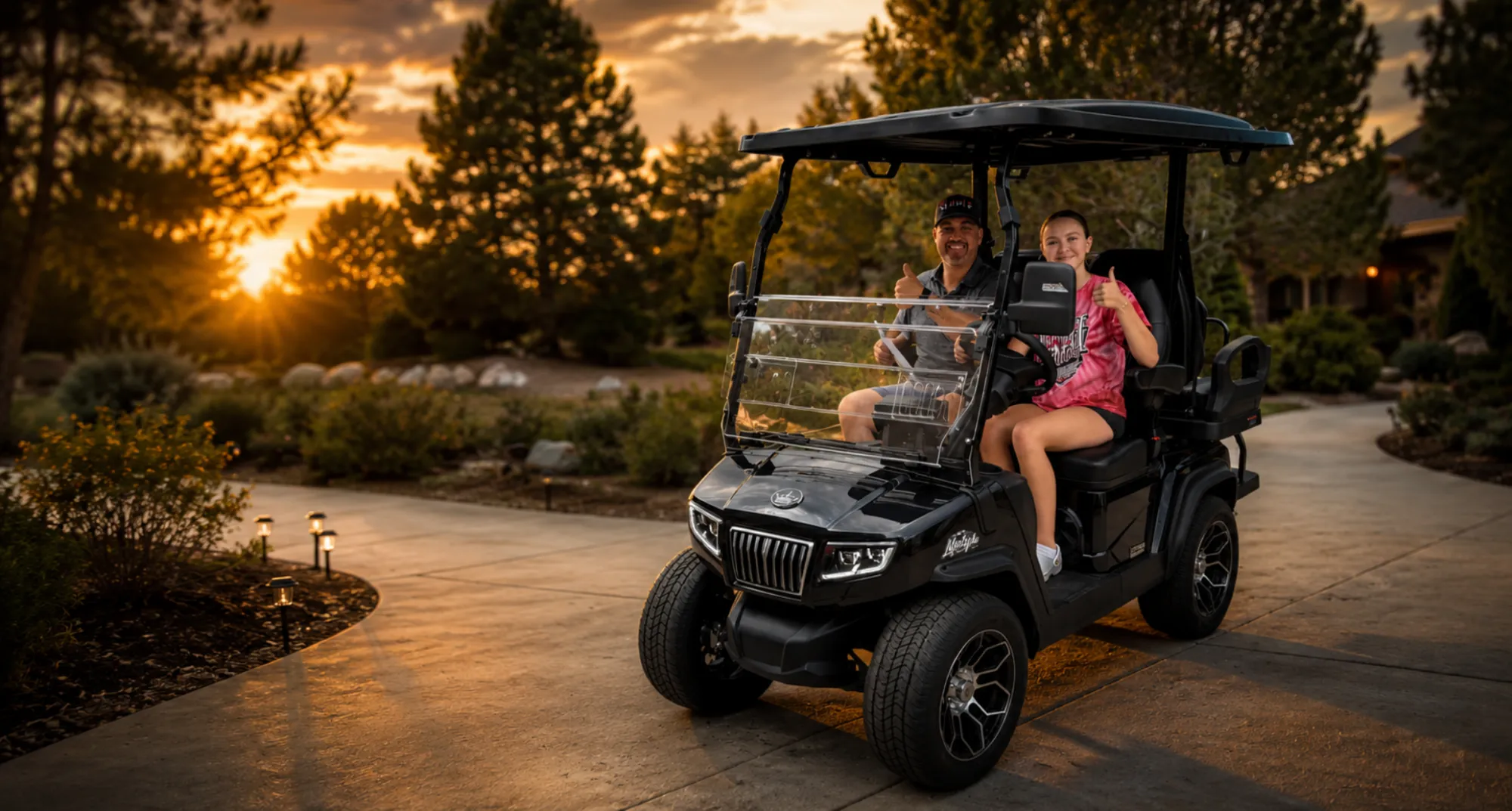
Top 5 Features to Consider When Buying a Golf Cart
Battery type, seating, suspension, lighting and street-legal equipment: the five golf cart features that change how a cart drives and what it costs to own.
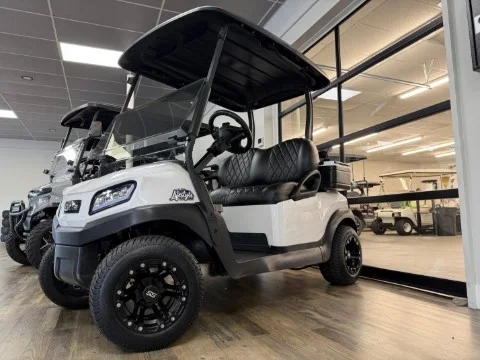
The five golf cart features that matter most when you buy are the battery, the seating layout, the suspension and tires, the brakes and lights, and the equipment the cart needs if you will drive it on a street. Everything else on a spec sheet, from the speaker bar to the cup holders, can be added later. These five decide how far the cart goes, who fits in it, how it rides and where you are allowed to take it.
TL;DR
Start with the battery: lithium packs now set the range and the running cost, and Denago, for example, publishes 40 or more miles from a 51.2-volt, 105Ah pack. Then count seats honestly, including whether rear passengers face forward or backward. Match the suspension and tires to where you drive, because a lifted cart with independent suspension rides differently from a low one built for cart paths. Look at the brakes and lights next; four-wheel disc brakes and full lighting are now common on new carts. Last, if the cart will go on public streets, check it against the federal low-speed vehicle standard, which lists exactly what a street-legal cart must carry.
1. The Battery Sets the Range and the Running Cost
Nothing on a golf cart affects ownership more than the battery. It decides how far you go between charges, how long charging takes, how much upkeep the cart needs and what you will spend when the pack wears out.
Most new carts now ship with lithium iron phosphate (LiFePO4) packs rather than flooded lead-acid batteries. On its Rover XL specifications, Denago lists a LiFePO4 pack at 51.2 volts and 105Ah, a range of 40 or more miles, a 5-hour charge time and a 5 kW or 6.3 kW AC motor. Those are the numbers to compare across brands: voltage, amp-hours, the maker's range figure and how it was measured, and the charge time.
| What to compare | Why it matters | What to ask |
|---|---|---|
| Battery chemistry | Lithium needs no watering and holds a charge in storage far better than lead-acid | Lithium or lead-acid? Factory pack or a conversion? |
| Voltage and amp-hours | Together they set how much energy the pack stores | What are the volts and amp-hours on the label? |
| Range figure | Makers measure it differently | At what speed, with how many riders? |
| Charge time | Decides how quickly a low cart is useful again | Standard and quick charge times? |
| Battery warranty | The pack is the most expensive part | How many years, and does it transfer? |
The best golf cart for long range
If range is your top need, compare stored energy rather than the range claim. A 51.2-volt, 105Ah pack holds roughly 5.4 kWh (volts times amp-hours), and a bigger pack at the same voltage goes further. Then ask how the range was measured. A figure taken with two riders on flat ground will not hold with six riders on the hills around Colorado Springs.
Environmentally friendly golf carts
An electric cart has no tailpipe and runs quietly, which is why neighborhoods and campgrounds tend to prefer them. Among electric carts, a lithium pack that lasts many years before replacement is the lower-waste choice over a lead-acid set replaced more often.
2. Seating: Count Riders, Then Look at Which Way They Face
A golf cart's seat count is the feature people most often get wrong, because they count today's riders and not next summer's. Families with children grow into a six-seater quickly; a couple who mostly golf rarely needs more than two.
Count next summer's riders, not today's.
The layout matters as much as the number. A "2+2" puts two rear passengers facing backward, which works for short trips and leaves the rear seat free to flip into a cargo deck. An all-forward four-seater puts everyone facing the front, which is more comfortable for longer rides and safer for kids who want to see where they are going. Denago sells both: its Rover XL seats four, and its Nomad XL is a lifted 2+2.
Best family golf carts
For a family, look for:
- Forward-facing rear seats, or a rear seat with a grab bar and a seat belt
- A seat belt at every seat
- Enough legroom in the back for an adult, since teenagers become adults quickly
- Storage for a cooler or bags that does not take a seat
3. Suspension, Lift and Tires Should Match Where You Drive
Suspension decides whether a cart feels planted or nervous on rough ground. Denago lists independent front and rear suspension on the Rover XL and Nomad XL, which lets each wheel move on its own over bumps. Many older and lower-cost carts use a solid rear axle on leaf springs, which is simple and durable and rides harder.
A lift raises the cart for ground clearance and room for bigger tires. It suits gravel drives, trails and properties outside town, and it makes the cart harder to climb into and a little less stable in tight turns. The tire choice follows the lift:
| Where you drive | Suspension and height | Tires |
|---|---|---|
| Cart paths and paved neighborhood streets | Standard height | Street or turf tires |
| Gravel roads and dirt drives | Mild lift | All-terrain tires |
| Trails, ranch land, steep unpaved grades | Full lift with independent suspension | Off-road tires |
Hilly ground deserves a mention here. Climbing and descending grades puts more load on the suspension, brakes and battery than flat ground, so a cart that will live on a hillside lot in the foothills should be judged on a hill during the test drive, not on a showroom floor.
4. Brakes and Lights Are Safety Features, Not Options
Brakes used to be the weak point of golf carts. On a hill, that shows. Many older carts stop with drum brakes on the rear wheels only. Newer carts increasingly carry disc brakes on every wheel; Denago lists four-wheel disc brakes on the Rover XL. More braking at each wheel matters most going downhill with a full load, which is a normal day in hilly country.
Lighting follows the same path. A cart used after sunset, or on any street, needs headlights, taillights, brake lights and turn signals. A cart used only on a private course in daylight can do without, but most owners end up wanting them. Ask whether the lights are factory-fitted or an add-on kit, because wiring quality varies.
Look for these together:
- Disc brakes, ideally on all four wheels
- A parking brake that holds the cart on a slope
- Headlights, taillights, brake lights and turn signals
- Mirrors on both sides or one outside and one inside
- A backup camera on larger carts, where rear visibility is poor
5. Street-Legal Equipment, If You Will Drive on Public Roads
This is the feature that decides where the cart is allowed to go. A street-legal cart is legally a low-speed vehicle, and federal standard 49 CFR 571.500 lists what one must have. It caps a low-speed vehicle at 25 mph and requires it to be equipped with:
| Required by the low-speed vehicle standard |
|---|
| Headlamps |
| Front and rear turn signal lamps |
| Taillamps |
| Stop lamps |
| Red reflex reflectors on each side toward the rear and one on the back |
| A driver's side exterior mirror, plus a passenger side exterior mirror or an interior mirror |
| A parking brake |
| A windshield meeting the federal glazing standard |
| A vehicle identification number under part 565 |
| A Type 1 or Type 2 seat belt assembly at each designated seat |
A cart that has the lights and mirrors but no VIN is still a golf car, not a low-speed vehicle. And a plain golf car is allowed on Colorado roads only where the city or county has authorized it by ordinance, under C.R.S. 42-4-111, so the rules in Colorado Springs, Monument and Pueblo can each differ. If you want to drive to the store or across a neighborhood, decide this before you buy, because adding a VIN later is not a bolt-on.
Are Electric Golf Carts a Good Option for Casual Players?
For most casual golfers, yes. An electric cart is quiet on the course, needs no fuel and, with a lithium pack, needs little upkeep beyond charging. A 40-mile range covers several rounds between charges for a typical player. The cases where a gas cart still makes sense are long days far from a charger and heavy work use. Our guide to choosing the right electric golf cart goes deeper on voltage, battery type and charging at home.
What Is the Best Golf Cart for the Money?
The best golf cart for the money is the one whose five features match your use, with nothing expensive you will not use. A couple who golfs and drives a quiet cul-de-sac do not need a lifted six-seater with a sound bar. A family on a gravel road outside town will regret a low two-seater. Decide the five features first, then shop by price within them.
That is also the honest answer to "what is the best golf cart to buy." There is no single winner. There is the cart that fits your riders, your ground and your streets, from a maker whose parts and battery warranty you can count on, sold by a shop close enough to service it.
Warranty belongs in the value sum too. Denago, for instance, says on its Rover XL page that it offers a lifetime warranty on the chassis, an 8-year warranty on its LiFePO4 battery and 2 years on other major parts and components. Compare the battery coverage across brands in particular; it protects the most expensive part on the cart.
Options beyond these five are worth weighing once the basics are right. Our custom builds cover lifts, wheels, lights, seats and sound, and the types of golf carts and how to pick one helps narrow the field if you are still choosing between gas, electric and utility.
What Can Wait Until Later
Plenty of golf cart features are nice to have and easy to add after you buy. They are worth knowing about so they do not distract you from the five that cannot be changed cheaply.
| Feature | Add it later? | Note |
|---|---|---|
| Sound bar or speakers | Yes | Bolt-on, many sizes |
| Underglow and accent lighting | Yes | Separate from the road lighting above |
| Rain enclosure | Yes | Fitted to the roof and windshield you already have |
| Rear cargo box or basket | Yes | Easier on a rear seat that flips to a deck |
| Seat covers and upgraded seats | Yes | Comfort, not structure |
| Infotainment screen and backup camera | Sometimes | Easier from the factory; Denago lists Apple CarPlay and Android Auto on the Rover XL |
| A bigger battery pack | Rarely | The charger, wiring and controller have to match |
| A VIN for street use | No | It comes with a certified low-speed vehicle, not a kit |
That last row is the one to remember.
The pattern is simple: anything that bolts on can wait, and anything that changes the drivetrain, the frame or the legal status of the cart should be right on the day you buy it.
Compare These Five Features on Carts You Can Drive
The quickest way to feel the difference between independent suspension and a solid axle, or a forward-facing rear seat and a 2+2, is to drive both. All the golf carts for sale on our Colorado Springs lot list their seats, power and battery type, so you can shortlist by these five features before you visit. Then come to Lifestyle Golf Carts at 2205 Montebello Square Dr. and drive the ones that made the list.
Frequently Asked Questions
What golf cart features matter most?
The battery, the seating layout, the suspension and tires, the brakes and lights, and street-legal equipment if you will drive on public roads. These decide range, who fits, how the cart rides and where you may take it. Accessories can be added later.
What golf cart has the longest range?
Compare stored energy, which is volts times amp-hours, rather than range claims. A 51.2-volt, 105Ah lithium pack stores about 5.4 kWh, and Denago rates its Rover XL at 40 or more miles. Ask how each maker measured range before you compare.
What is the best golf cart for a family?
Look for forward-facing rear seats or a rear seat with a grab bar, a seat belt at every seat, room for an adult in the back and storage that does not use a seat. Many families outgrow a four-seater and choose six.
What features does a street-legal golf cart need?
Under the federal low-speed vehicle standard it needs headlamps, turn signals, taillamps, stop lamps, reflectors, mirrors, a parking brake, a compliant windshield, a 17-character VIN and seat belts, and its top speed is capped at 25 mph.
Is lithium worth it on a golf cart?
For most buyers, yes. Lithium needs no watering, keeps its charge in storage far better than lead-acid and often carries a long battery warranty, such as Denago's 8 years on its LiFePO4 pack. It costs more up front and usually less over the cart's life.