Why Electric Golf Carts Are Taking Over in 2025
Why electric golf carts took over in 2025: lithium packs, longer range, quieter neighborhoods and street-legal use, and the 2025 electric models worth a look.
The 2025 electric golf carts pulled ahead of gas for three plain reasons: lithium batteries became the standard pack on new models, the carts started doing jobs well beyond the golf course, and charging one at home costs very little. In Colorado Springs, a full charge of a typical 2025 lithium pack costs about 53 cents at the utility's off-peak rate. Gas carts are still sold, but for most buyers the decision now starts with electric.
TL;DR
Electric golf carts took over in 2025 because the new models changed. Brands like ICON, Denago EV and Evolution build electric carts around lithium packs, and ICON's 2025 lineup alone runs to ten electric models, each with an on-board cord that plugs into a standard 110-volt outlet. Lithium removed the watering and the weight of lead-acid, and it stretched range to 40 miles or more on models like Denago's Rover XL. Carts also moved off the course into neighborhoods, resorts and campuses, where quiet matters. At Colorado Springs Utilities' standard time-of-day rate, filling a 5.4 kWh pack off-peak costs about 53 cents before charger losses. Gas still makes sense for long days far from power and for heavy work.
Are Most Golf Carts Electric Now?
Among new personal golf carts, electric is where nearly all the new models are. Several of the brands we carry, ICON, Denago EV and Evolution among them, build their personal lineups around electric power and lithium packs. E-Z-GO and Club Car still offer gas versions of popular models, and even ICON lists a separate "2025 Gas" category on its site, so gas has not disappeared.
What we cannot give you is a reliable national share for electric versus gas. We have not found a published count we would stand behind, so we will not quote one. What we can say is what the lineups show: the new designs, the new features and the new seat layouts of the last two model years arrived on electric carts first, and often only on electric carts.
Are golf carts electric by default?
Not always. Golf courses have run both for decades, and older used carts on any lot are a mix of gas and lead-acid electric. If a listing does not say, check for a fuel cap and an exhaust pipe, or a charging port and a battery compartment, before you assume.
Lithium Became the Standard Pack in 2025 Models
The biggest single change in the 2025 electric carts is the battery. For most of golf cart history, an electric cart meant a set of flooded lead-acid batteries that had to be topped up with water, weighed a lot and lost capacity if left uncharged. The 2025 models from the electric-first brands moved to lithium as standard.
On its Rover XL specifications, Denago lists a LiFePO4 (lithium iron phosphate) pack at 51.2 volts and 105Ah, a range of 40 or more miles and a 5-hour charge time. ICON says every one of its EVs carries its Eco Lithium battery, and quotes a 10-year warranty on it alongside a 3-year limited warranty on the cart.
| What lithium changed | Lead-acid carts | 2025 lithium carts |
|---|---|---|
| Watering | Needed every few months | None |
| Storage over winter | Loses charge and can be damaged if left flat | Holds charge far better |
| Battery warranty quoted by makers | Usually short | ICON quotes 10 years, Denago 8 years |
| Charging | Dedicated charger | ICON: on-board cord to a 110-volt outlet |
Longer battery warranties are the quiet signal here. A maker quoting 8 to 10 years on a pack is telling you how long it expects that pack to last, and that changes the math on owning an electric cart for good.
What a Charge Costs in Colorado Springs
The running cost is where electric carts win most clearly, and here we can put a local number on it. The Colorado Springs Utilities residential rate sheet, dated October 1, 2026, prices electricity per kilowatt-hour in three parts on its Energy Wise standard time-of-day option: an access and facilities charge, an electric cost adjustment and an electric capacity charge. Add them for off-peak hours and you get about $0.098 per kWh.
A 51.2-volt, 105Ah pack stores about 5.4 kWh (volts times amp-hours). That puts a full charge from empty at:
| Colorado Springs Utilities option and time | Cents per kWh, all three charges | Full 5.4 kWh charge |
|---|---|---|
| Standard time-of-day, off-peak, winter or summer | about 9.8 | about $0.53 |
| Standard time-of-day, on-peak (5 to 9 p.m. weekdays), winter | about 18.9 | about $1.02 |
| Fixed seasonal option, winter (October to May) | about 10.9 | about $0.59 |
| Fixed seasonal option, summer (June to September) | about 13.5 | about $0.72 |
Those figures leave out charger losses, which add a little, and the daily access charge, which you pay whether or not you own a cart. They also assume you start from empty; most top-ups cost less.
The practical takeaway: plug the cart in after 9 p.m. on weekdays, or any time on weekends. Even three full charges a week at the off-peak rate come to about $7 a month. That is a big part of why electric carts took over.
Why Are Golf Carts Becoming Popular Beyond Golf Courses?
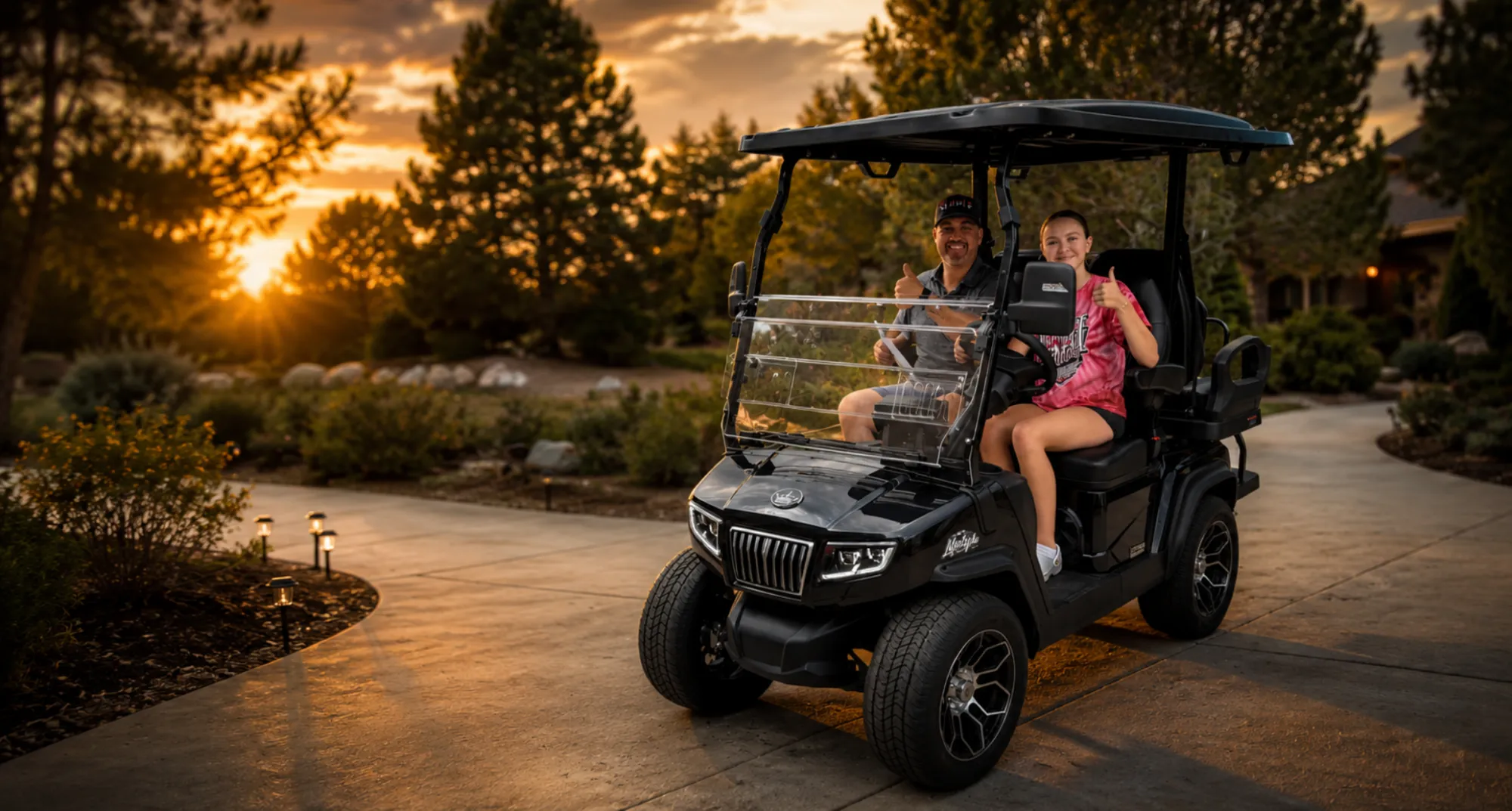
Golf carts became neighborhood vehicles because the carts themselves grew into the job. The 2025 electric models arrived with headlights, turn signals, seat belts, mirrors and backup cameras, which used to be add-ons or simply absent. ICON describes its EVs as street-legal golf carts approved for low-speed travel in most states, equipped with turn signals, seat belts, LED lights, rearview mirrors, horns and digital gauges. Denago pitches its Nomad XL for "neighborhoods, resorts, campuses, and everywhere in between."
Three things pushed carts off the course:
- Quiet. An electric cart does not wake a street at 7 a.m., which matters in neighborhoods and campgrounds.
- Road equipment. A street-legal low-speed vehicle carries the lights, mirrors, belts and VIN a road needs, and the 2025 models were built that way from the factory.
- Seating. Forward-facing four- and six-seat layouts made carts practical for families rather than two golfers and their bags.
In Colorado Springs, Monument, Fountain and the other towns around us, where you may drive a cart depends on whether it is a titled low-speed vehicle and on what each town allows. Decide how you plan to use it before you buy, because that decides which cart is right.
Plug-In Charging Got Simpler
Charging used to mean a separate charger box, the right plug and a spot in the garage set aside for it. The ICON 2025 electric lineup says each of its EVs has an on-board charging cord that plugs into any standard 110-volt outlet. Denago lists a 5-hour charge time for the Rover XL.
That simplicity matters more than it sounds. An owner who can plug in anywhere tops up more often, keeps the pack in a healthy range and never ends up with a flat cart before a weekend. It is one of the reasons people who bought a gas cart years ago are switching.
Charging in a Colorado winter
Lithium packs come with temperature limits for charging. Check your cart's spec sheet for its charging range, and if your garage sits below freezing in January, bring the cart somewhere warmer before you plug it in.
The 2025 Electric Golf Carts Worth a Look
These are 2025 electric models from brands we sell and service, from each maker's own published information:
| Brand and model line | Seats | Battery as published | Notes |
|---|---|---|---|
| ICON i20X, i40X, i40FX, i60LX, i20sX, i20uX, i20uX-F | 2 to 6 | Eco Lithium, 10-year battery warranty quoted | On-board 110-volt charging cord; ICON lists them as street legal |
| EPIC E20FX, E40FX, E60FX | 2 to 6 | Eco Lithium (ICON family) | Sold under the ICON family of brands |
| Denago Rover XL | 4 | LiFePO4 51.2 V, 105Ah, 40+ miles | Independent suspension, 4-wheel disc brakes |
| Denago Nomad XL | 2+2, lifted | LiFePO4 51.2 V, 105Ah, 40+ miles | Lifted for gravel and trails |
Our favorite electric golf carts, then and now goes deeper on which ones we would pick and why. If you are weighing the model years side by side, the 2025 golf cart models buyer's guide covers the lineups brand by brand. Atlas is another lithium brand on our lot, and the Atlas electric golf carts in stock show what its current models look like.
What Is on Our New-Cart Lot Right Now
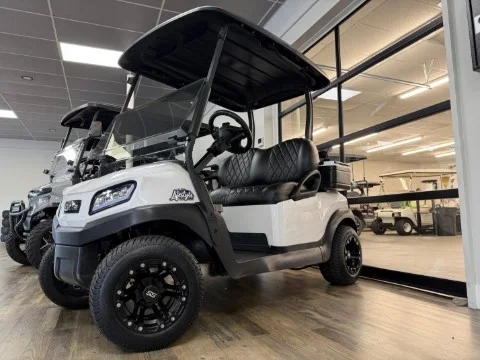
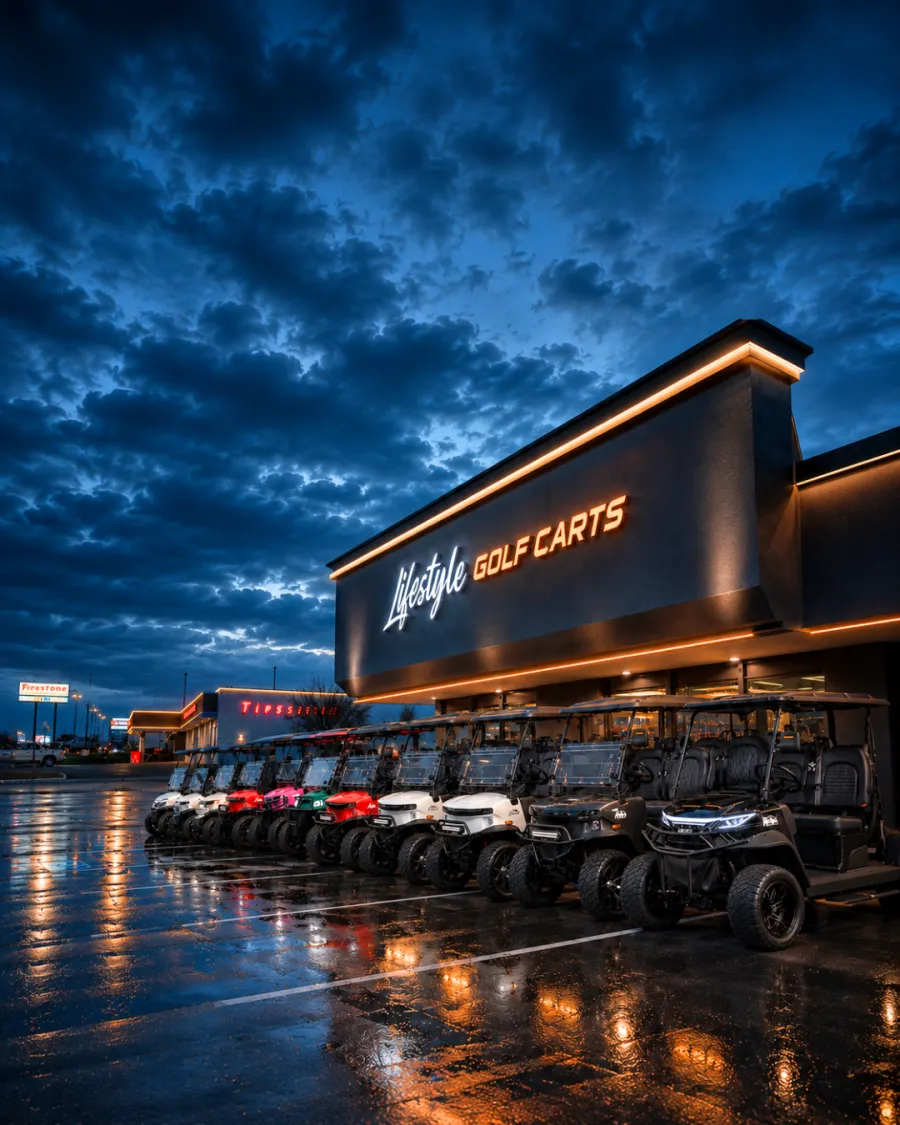
The clearest local sign of the shift is our own new inventory. The week we wrote this, all 27 new carts on our Colorado Springs lot were 2026 lithium electric models. Not one was gas.
| Brand | New models on the lot that week | Carts |
|---|---|---|
| Atlas | Pro 2 Passenger | 6 |
| Denago EV | Nomad XL Gen 3, Scout 2, Rover XL Gen 3, Rover XL6 | 9 |
| ICON | i40X, i20X, i40FX, i60LX | 6 |
| EPIC | E40FX, E20FX | 2 |
| TEKO | Trophy Plus | 2 |
| Venom EV | Strike 2P, Stealth 4P | 2 |
That is six brands, two-seaters to six-seaters, lifted and not, and every one of them lithium. It matches what the makers' own lineups show: the new models are electric first, and the newest features arrive on electric carts. A buyer walking our lot sees the shift without reading a single spec sheet.
Inventory moves every week, so the mix on any given day will differ. The pattern does not.
Buying a Used 2025 Electric Golf Cart
The first 2025 electric carts are now showing up on the used market as owners trade up. They can be strong used buys, because their lithium packs may still have years of their warranty window left. A few checks are specific to them:
- Battery warranty. ICON quotes 10 years and Denago 8 years on their lithium packs. Ask whether the pack was registered, when the clock started and whether the coverage passes to a second owner. Terms differ by maker.
- Charging. Make sure the charging cord or charger is with the cart. On an ICON, the cord is on board; on other brands it may be a separate unit.
- Electronics. Test the touchscreen, backup camera, lights and turn signals. These are the features that made 2025 carts different, and they are what you are paying for.
- Street-legal status. If it is sold as a low-speed vehicle, find the 17-character VIN and the paperwork that goes with it.
- State of charge display. A lithium cart's battery display should read sensibly after a full charge. A display that drops fast on a short drive deserves a closer look.
Our used golf cart inspection checklist covers the rest of the checks, from the frame to the test drive.
Where Gas Still Makes Sense
Electric took over most of the market, not all of it. A gas cart still earns its place when:
- You drive long days far from an outlet, such as a large ranch or a hunting property
- The cart does heavy hauling for work every day
- You need to refuel in minutes rather than recharge for hours
For everyone else, the cost per charge and the near-zero upkeep make electric the better default. The details, from hills to five-year cost, are in our gas versus electric golf cart comparison.
Drive a 2025 Electric Cart Before You Decide
The difference between a lithium cart and an older lead-acid or gas cart is obvious in the first minute: quieter, quicker off the line and nothing to fill. The new golf carts for sale on our Colorado Springs lot include lithium electric models from the brands above. Come by Lifestyle Golf Carts at 2205 Montebello Square Dr. to drive one.
Frequently Asked Questions
Why are electric golf carts taking over?
Lithium packs became standard on new models, removing watering and stretching range to 40 miles or more on carts like Denago's Rover XL. Carts also took on neighborhood and campus jobs where quiet matters, and charging at home costs very little, about 53 cents a full charge off-peak in Colorado Springs.
Are most golf carts electric?
Most new personal golf cart models are electric, and several brands build only electric carts. E-Z-GO and Club Car still sell gas versions, and older used carts are a mix. We have not found a reliable national count of electric versus gas, so we do not quote a share.
How much does it cost to charge a golf cart in Colorado Springs?
At Colorado Springs Utilities' standard time-of-day rate, about 9.8 cents per kWh off-peak, a full 5.4 kWh lithium pack costs about 53 cents before charger losses. Charging on-peak, 5 to 9 p.m. on weekdays, costs about $1.02 in winter.
Why are golf carts becoming popular beyond golf courses?
The 2025 models came with road equipment like lights, turn signals, mirrors and seat belts, forward-facing family seating and quiet electric drive. That made them practical for neighborhoods, resorts and campuses, where they now do many short trips a car used to.
What are the best electric golf carts of 2025?
The best one depends on seats, range and where you drive. From the brands we carry, ICON's i40X and i40FX, the EPIC E40FX and Denago's Rover XL and Nomad XL are strong four-seat lithium choices. Compare battery size and warranty first.